

Escape the Infected:
Brighton's last stand
Game design
(International Educational Games
Competition)
An Escape room game made to make Library orientation at University of Brighton more interesting with a gamified learning experience.
The
Challenge
The University of Brighton's Aldwich Library offers a variety of resources and amenities to students. Despite thorough explanations during library orientation events, some students either do not attend or forget the most of the details. As a result, students may become disoriented, confused, or uninformed of useful resources that could considerably improve their academic experience.
The
Goal
This project was done in a group of 5. Our goal was to understand the problems that students were facing while using the library and facilities they were missing on and create a gamified learning experience through an escape room game.
What I Did
UX designer
Game designer
My Tools
Figma
Photoshop
Genially
Miro
Duration
Overall: 3 months
Discovery & Research: 2 months
Design & testing: 1 month

The
Process
Empathise
Define
Ideate
Prototyping

Testing
Background
study
Empathise phase
For students, the University of Brighton provides a seamless blend of online and offline experiences. Students can easily borrow and return books, use computer facilities, request assistance from skilled help desk staff, access a wide choice of research papers and journals, and use specialised study spaces in the physical library.
Online library services, on the other hand, allow quick access to a large array of both physical and digital materials, such as books, research papers, databases, and video content via Box of Broadcasts. Students benefit from focused research and technical assistance, prioritised accessible features for students with disabilities, and the ease of remotely accessing tools like VPNs.

In order to develop a more thorough grasp of the requirements and preferences of both undergraduate and postgraduate students, we also conducted a number of one-on-one interviews with them. we also took an Interview of the librarian to understand the comprehensive library offerings, typical student enquiries and the knowledge gap amongst the students for specific subjects or elements that students may not be familiar with of the library.
One-on-one Survey
We collected statistical data on students' library experiences and preferences by using quantitative surveys with a QR code that was extensively circulated throughout the library. The goal was to discover specific issues, understand library service needs, expectations, and preferences, and investigate what students normally seek or anticipate in their experiences with library facilities.
Online Survey
Segregating
information
We analysed the information gathered once our surveys and interviews were finished. We took advantage of affinity diagrams to speed up this procedure. This tool helped us make sense of the material we had acquired. We were able to find patterns, themes, and linkages by putting similar observations and insights together. With the help of this analytical strategy, we were able to reduce the volume of data into digestible and insightful bits.

Where was the
problem?
Pain points
1
Difficulty using OneSearch
They have trouble using OneSearch, the main research tool the university offers.
3
Lack of information
They are unaware of the Box of Broadcast, a useful tool for finding media resources for education.
2
Problem booking study room
They face problems finding and booking study locations, which makes it difficult for them to find places that are appropriate for group work or solitary study.
4
Navigating in Library
They have issues while locating books in the physical library
Persona
we used insights gained through interviews with undergraduate and postgraduate first-year students to make these 2 personas We were able to use our experiences as part of building the user personas for this project as we are part of the primary target audience group of this project’s game.

Starbursting
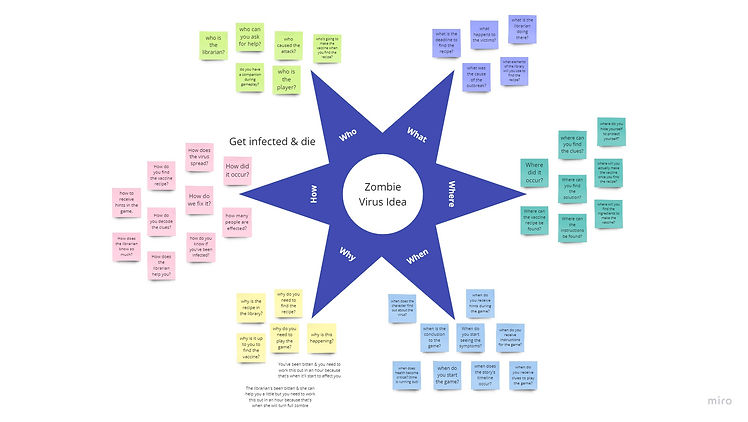
After Brainstorming our ideas for the storyline, we zeroed in on the zombie storyline for the starbursting brainstorm. The Empathise & Define stages of this process informed us that our target audience consisted of young people, most of whom were technology friendly. A safe assumption to make about these young people at this time would be that some of them are players of video games and some of them stream TV series.
Storyboarding
The following storyboard was produced to represent the basic notion of how players would explore the game. They would then enter the game and solve a series of riddles to get passwords and progress through the game's stages.
.png)
Ideas for
puzzles
Upon solidifying the storyline, our team engaged in mind mapping sessions to brainstorm and generate creative puzzle ideas. We meticulously compiled a list of potential puzzles to be incorporated into the project.
.jpg)
Hi-fi prototype
prototype
The game was made with the help of genially, a platform that helps create games. Eva, a non-binary librarian dealing with a zombie bite and a one-hour countdown, is guiding the player through the tasks. Eva supports players in solving puzzles to reveal crucial passwords needed to progress through the game.
View Figma prototype


Problem focus
The game is easy to begin, featuring straightforward puzzles with no specific rules. Complexity varies alternately with seven puzzles, including Sudoku, Pigpen, and ciphers. After puzzle completion, players navigate to the university's library website, engaging in tasks and submitting answers. This interactive approach enhances library recall and transforms learning into an enjoyable experience.
Game play
testing
testing
Our game was tested with a broad group of 20 people, including library experts, newcomers, and students. Three members of a tabletop gaming club with escape room experience provided further insights. The evaluation included two types of testing: Tasks & Severity Testing and Think Aloud. They provided a comprehensive understanding of the game's effectiveness and user experience.
1
Tasks & Severity Testing
We had users perform tasks on the university's library website before, immediately after, and one week following the game. Notably, when assessing their memory retention a week later with the same tasks, an impressive 80% of participants successfully completed them.
2
think a-loud
We did Think Aloud testing while users were playing the game, gaining vital input. This feedback was then integrated into the game's improvements ensuring a user-centric and refined gaming experience.
Game play
testing
The users were provided with a debriefing leaflet after the game. The testing phase yielded highly positive results. During interviews with participants, an overwhelming majority expressed that they thoroughly enjoyed playing the game and found it to be a more engaging learning experience compared to traditional methods.
.png)